Sunday, September 25, 2016

The Apple is a Peach


When I was employed, one of my favorite holidays was Columbus Day. When I briefly left education in the late 1970’s, I found I missed kids terribly. When I decided to return to teaching a year later, people at my plant asked me why I was returning to education. I lied and said it was because I didn’t want to work on Columbus Day. It was only partially a lie.

Enjoyment wasn’t based on the commemoration of Columbus. It was the timing of the day. Early October has mostly cool, clear, dry days. These days are perfect for fishing. As educators, we got the day off and that meant fishing trips. 

One day Paul said, “Hey guys, I read they are catching some nice smallmouth bass on the Apple River in northern Illinois. We should go on Columbus Day.” We were all four available and decided this would be our next fishing destination. The Apple flows through Apple River Canyon state park and eventually flows into the Mississippi on the edge of the old Savanna Army Depot.

Paul called the ranger station at the state park and received some fishing advice and directions. This was before GPS so we actually needed a map.

The Apple is a shallow cool water creek. In this area it is shallow enough to wade. The cooler October weather meant we would need waders (high waist boots for you non-fisher people). 

For Don and Paul this was prime water for fly fishing. Robert and I brought our trusty spinning rods and lures we purchased from our Smokys trip.

It was a long four hour drive from Bloomington. We arrived around noon, and stopped to eat our packed lunches. Fortunately Don’s wife, Pat, had prepared many sandwiches. I brought basic staples like Cheetos and snack bars.

After lunch we put on all of our gear and waded into the river near the parking lot in the park. We caught fish quickly, but they were not smallies. The only fish were small minnow like creek chubs called dace. They were about 3 inches long with bumps all over the head. They may have gotten a few more bumps as we pitched them back immediately.

The park has limestone bluffs which line the river. The Apple has three branches in the park and they have an unusual flow pattern. The water from two of the branches enters the main branch, but they flow against the current. I learned later that uplift changed the river’s course and the main branch was at one time a tributary.

In spite of the scenic beauty, the fishing was disappointing. We decided to ask advice at the ranger station. This was a great move as the ranger pointed out other Apple River areas owned by the state. These areas, separated from the main park, were purchased as farm land was put on sale. Some of the land was owned on one side by the state and the other by private owners. The ranger said these sections were fished less often and almost no one fished them in the fall.

Though we are navigationally impaired, we actually managed to locate one of the sections. It was across the road from a Boy Scout camp, and we were able to park there. Unfortunately they were having a big jamboree, and the parking areas were packed. We hoped we didn’t get towed. After putting on all our gear, we waded into the edge of a corn field and mostly stumbled until we found the river. We had to slide on our butts to get in the water, but all managed to get in without falling.


The shallow water was crystal clear and we could easily see fish facing upstream waiting for food to swim by. Don and Paul fished with their tree snagging poles (fly fishing) while Robert and I fished with spinning equipment. The guy in the picture caught the first smallmouth.


We moved upstream as we tried different pools. In most places the river barely covered the bottom of my boots. It was narrow, and  in many spots less than 20 feet across.


This section of the river has many bluffs. Next to the bluffs, the river is much deeper, sometimes over 5 feet. As we were fishing a deep pool, something hit the water next to Don. It sounded like a cannon when it hit. We thought some kids were up on the bluff throwing rocks at us (Don). We watched the bluffs and waited for them to throw again. They did….it was a squirrel knocking down walnuts from a tree overhanging the bluff.


As we moved upstream, the ranger said to look for a bridge. This was the end of state property and we were not allowed beyond the bridge.  I found out later that my brother-in-law, Gregg, was part of the crew that built this bridge. This was an extremely steep bank to climb and we all had difficulty getting out. I wish he had put in a few steps to the top. Across the bridge lay more scenic bluffs, but there were beef cattle grazing the area and wading in the river. Since they were upstream, the water under the bridge was "unpleasant".

We had a mile walk, in boot waders, back to the car parked at the Boy Scout camp. After the mile long hike in boots against the current and then the hike back we were exhausted. However we caught many smallies along the way and had a wonderful time looking at the scenery and catching fish.

As we loaded into the car, for the long drive home Paul said, “The title will be "The Apple is a Peach’ ”. I asked what that was about. He said he wrote a journal when he went fishing. Each journal entry had a title. I thought the title was a perfect description of our adventure.

We returned many times, often in the summer as you can tell by the change in wardrobe. 

We caught many fish, including some really large river smallies. We explored more of the river. The area near the Boy Scot camp begins at another bridge and it contains several deep pools. We met a nice woman who owns a house on that section that she and her husband purchased for retirement. He had passed away, and she seemed to enjoy talking to us. One time we caught so many smallies in a deep pool near her house, we never waded upstream. We actually ran out of the crawdad lures we were using and couldn’t find any more in the area.

Often it was just Don and I returning, but we always considered the Apple a special place. We extended our trips to two days and included some sightseeing. This area of Illinois is untouched by glaciers and is extremely hilly and scenic. It is home to the highest land in Illinois, known as Charles Mound. The highest town in the state is nearby Scales Mound, a very small village, and home of two brothers who lived next door to me in college. I had uncles who farmed near there, and visiting them was the best part of summers.


Educators now can waive the state of Illinois requirement to dismiss school on holidays. Many districts have chosen to stay in school on Columbus Day. Now, when I fish on Columbus Day all those educators and kids are in school. Seriously, I don’t miss Columbus Day, but I am forever thankful that we made that first trip. The Apple really is a Peach. 

Credit Paul for the title and the photos.

Friday, September 16, 2016

Fishing with Kreuder and Dolan

I explained in an earlier post why I feared fishing on the Mississippi. Although I spent 11 years living in river towns, I only ventured out in a boat to fish one time. This was with my teaching buddy and long time friend, known by everybody as Kreuder.

Gerry(pronounced Jerry)  grew up in Savanna also on the Mississippi. Boating was a family tradition. In addition to being on the river almost every week-end, he was also trained as a rescue diver for the fire department.

Gerry loved to ride up and down the river, water ski, camp on sand bars and swim in the river. It seemed all his family fun centered around the river. He had a large powerful boat to do all this .

We were also friends with Kenny Dolan, who was the local postmaster. Kenny was married to Evelyn, a wonderful teacher, who mentored me through my first year. Kenny was the best known person in Albany mostly because you had to go to the post office to get your mail. Kenny was a disabled veteran and had been injured in WW 2. He was unable to use his right leg. Despite his injury he was the most affable, positive person I knew.

One day, Gerry decided to take Kenny and I out fishing on the Mississippi. Kenny could barely walk along the dock and crawl into the boat.Gerry didn't fish, Kenny couldn't swim, and I was just plain afraid. Despite this prescription for disaster, we headed out onto the mighty Mississippi.

After a little excursion up and down the river, Gerry decided to pull us into a small bay in a river island, known as Beaver Island.. He dropped an anchor and we cast our lines. After a few minutes of no fish, Kenny managed to snag his line. 

Kenny tried to free the line, by crawling out on the bow of the boat. Both Gerry and I were afraid he would fall in and tried to convince him to let us help.I ended up crawling out on a tree limb to free his line.

Having experienced near disaster, we decided a boat ride would be better than fishing.We finished the morning riding up and down the river. The only remaining excitement occurred when Kenny tried to get out of the boat and walk on the constantly moving dock. Fortunately he made it without falling in.

I don't know if our trip was part of the motivation, but Kenny began to push for a fishing park along the shore of the Mississippi. He wanted a place for kids and parents to fish safely. 

The local Lions club rallied to support his effort. Gerry was one of the leaders in the club and helped support this effort. A small former dump was cleared and leveled. The bank was gently sloped to the water so that anyone could access it. A small parking area was formed along the highway The club installed a few picnic tables and erected a sign.

This is my then four year old son, Scott, fishing at Dolan Park.


Gerry remains a life long friend, although we don't see each other often. He still boats in the Mississippi, but I don't think he fishes much. Kenny passed away over 40 years ago, but you can still fish along the Mississippi in Dolan Park, a great tribute to a great man.
credit Gerry for adding accuracy and Connie for pictures

Sunday, September 11, 2016

Our latest rescue


We did manage to accomplish an unusual rescue. This occurred in Don’s boat. Paul had told us the DNR people were returning trapped muskies and walleyes to the main lake. Lake Evergreen has a catch area below the dam. Fish that swim or are washed over the spillway, land in this area which is fenced so they cannot escape down the creek.

Paul said they were being returned right off the dam and several had exceeded 36 inches.  This sounded like a great place to catch a trophy. Paul had to work, so Don and left for the lake.

We started fishing around the dam area, but had no luck. As we approached the dam, we saw a truck pull up on the road nearby and several DNR personnel and multiple volunteers began carrying fish out onto the dam and setting them in the water. The fish were quite large and Don and I figured they would be hungry and biting.

As we watched the people put the fish in the water we saw that a number of the fish were in distress. They were floating on their backs and people were trying to revive them by turning them over and moving water through their gills. Unfortunately some of the fish floated too far out for the people to help them.

We looked at each other and realized we should not be fishing. We put up our poles and Don drove us in towards the dam near the floating muskies. We asked if we could help.

By this time several of the muskies were more than 20 ft. out from the dam. Don moved us slowly in alongside two of the big girls. I snapped these pictures from a distance before putting down my phone.


It was quite a thrill to see such an enormous fish up close. Muskies are  powerful predators. They have multiple rows of razor sharp teeth. Muskie fishermen use steel leaders to keep the fish from cutting the line. They have wide flat heads and eyes that are set back like a hawk. A muskie is a killing machine.

In spite of their huge head and ferocious jaws, these fish were not a danger. I slipped my hand under one’s back and turned her over. As I supported her belly, I began to move her forward to get water moving over her gills. Slowly she began to pump water through her gills. A few moments later, she slowly dove into the deep water. Don was doing the same thing off the bow.

Don and I repeated this two more times before the rest of the muskies recovered and moved down. The DNR volunteers thanked us as we pulled away to go back to the dock.

We never caught fish that day, but it was a truly satisfying morning.  At least Don and I can say we caught several trophy muskies with our bare hands.

Sunday, September 4, 2016

Two Rescues


There are moments on the water when we actually did something right and other boaters were ill prepared. I vividly recall launching a rental boat at Clinton Lake, while two inebriated guys were preparing to pull off the lake. One buddy threw the truck keys to the other. Result, diving for sunken keys. There was the time I saw the Evergreen Lake staff rent a motor boat to a family and the father claimed to know how to run the motor. After zig zagging around trying to figure how to steer, he rammed the boat into the dock. Fortunately his family was waiting on the dock and was not injured.

After the elderly (e.g. older than me) gentleman helped me recover my wayward boat (Adventures in Rick's Boat), I vowed to always assist someone in need while on the water. These are two tales of this happening.

First Rescue
I was fishing alone at Lake Evergreen. I was moving to a new location and encountered two people in a stalled boat. One, obviously the father, was cussing at his partner, obviously his teenage son, about failure to put fuel in the boat. They had managed to pull start the motor and go just a distance before they ran out of fuel. They were quite a distance from the main dock had no means of reaching that distance.

I pulled up and offered to help. The dad, still cussing at his son, told him to throw a goddamned rope to me so I could pull them in. I attached their line to one of my boat rope cleats and fired up my big motor and slowly pulled them toward the main dock.

As we moved closer, the father said to unhook the rope and they would use the trolling motor to get to the dock. I threw them the rope and moved back. I was still close enough to hear the father begin cussing at his son again because the trolling motor battery was dead. They had failed to recharge it. Fortunately they were close enough to the dock to paddle the rest of the way. Dad was still cussing at his son as I fired up my motor and left the area. I wonder if the kid will ever enjoy fishing.

Second rescue

Don and I decided to fish Shabbona Lake in northern Illinois. The lake is famous for muskies and crappies. The lake has a 10 hp limit. We took my boat and headed north.

Because it was summer, the lake was quite busy. It is a very small lake and one side is quite shallow. In the shallow area there are numerous tree stumps. Many are just under the surface.

As we moved into that area we saw a family of about 6 people sitting on one of those stumps. The large group could not get off the stump.  The oldest member of the group, probably the grandfather, was revving the motor to try and push off. The 10 hp motor simply was not powerful enough to push the heavy load over the stump. The stump was under the boat so there was no place to get purchase and push.

Since my boat has a 25 hp motor, as well as a 9.9, Don and I offered to help. We had the teenage boy in the front throw us a rope. Don stayed in the back and tied the rope to a cleat. I fired up the 25 hp and Don watched the stuck  group.

With a roar of the motor we were able to pull them off. Don threw back the rope and we waved as we slowly continued to fish around the stumps. We figured they were heading in.

About twenty minutes later we started to move to another area. As we were ready to leave the stump area, we saw the same family again. They were stuck again on another stump. We pulled up, had the same kid throw Don the same rope and pulled them off again. This time they headed for the boat ramp.

We caught one crappie that day. 

Our biggest catch was the stuck family.


Sunday, August 28, 2016

Playing the Drum


In late October 2011, I asked Don to join me for fishing on Lake Evergreen. The day was cool and cloudy, but we wanted to get in one more trip before shutting down for winter.

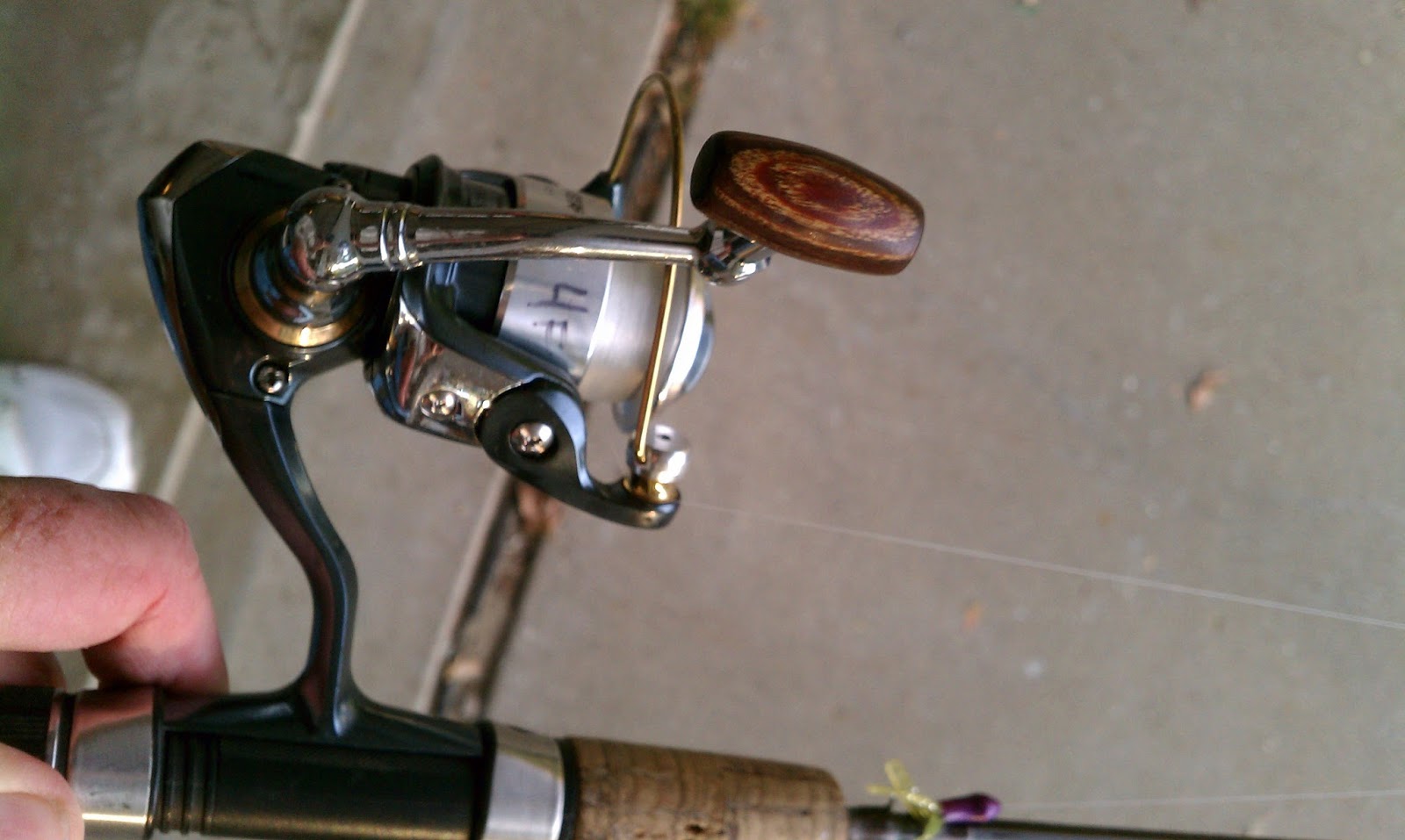
We had good luck fishing that year, especially for fishing for crappies. I had located several areas along downed trees and back in coves. These areas were productive all season with various baits. My usual bait was a small jig with a wax worm attached, but I also fished with minnows. Because the bite of a crappie is so delicate, I purchased a Shimano ultra-light carbon fiber rod. It is thinner than a number 2 pencil. I fished with ultra-thin 4 lb. test fluorocarbon line and a Pflueger ultra-light President reel.


Earlier that spring I had special ordered some tiny jigs for crappie fishing. These jigs were only found on line. The jigs were tube jigs 1 inch in length. These puppies were small, but crappies like small baits.

To complete the rig, I used jig heads ranging in size from 1/64 oz. to 1/80 oz. I tried to buy these at Bass Pro Shops, but there were none that small in the fishing section. Fortunately I wandered into the fly fishing area and found a few. The rest I ordered on line. I even ordered some 1/124 oz.  These are so small they won’t sink.

The tubes came in many colors and all colors worked depending on conditions. Light colors worked well in the clear spring water, red and bright colors worked well when Evergreen became green in the summer. However, the best producing color in all conditions was purple.


For this trip, I purchased minnows. The bait shop was out of “crappie” minnows, which are the small ones. Fishing was slowing down and vendors were not carrying many baits. I purchased medium size minnows.

Why all the details? It is to let you know how light my tackle was that day. I was expecting to catch crappies that might weigh 12-14 oz.

Our first stop was along some downed trees on the main lake area. I thought we could jig there for a while before heading into a cove, where there was less wind. As usual, I fished off the bow and Don was in the back.

After jigging the minnow up and down for a few minutes, I got a strike. The strike was not hard, but I couldn’t move the fish up. I thought I might be snagged, but then the fish began to move away from the boat. Walleyes and catfish stay down when they are caught. I was sure it wasn’t a crappie and likely one of them. Evergreen holds the state record for hybrid walleyes. I thought I might have a trophy.

It circled back towards the boat and headed towards the back and the motor. I kept worrying it would snag around the motor or break the line. The whole time I thought about the masterful way I had seen Paul land the muskie on our first trip to Lake Shelbyville (See Almost Holiday). I tried to do what I remembered him doing.

The fish dove under the boat and I kept moving around the boat trying to keep the line clear of the gear in the boat. We made several trips around, with Don always scrambling to get out of the way as I let the fish decide which direction to go. He asked if he could help, but this was a one person task. With a u shaped rod, I kept tension on the fish but never pulled or tried to “horse” the fish. When your tackle is so under sized, your only hope is to play the fish until it tires and prevent it from wrapping you around a log or snapping your line.

Suddenly the fish turned and started to pull line against the drag on my tiny reel. It was headed out in the main lake towards the dam. The reel was whining against the drag, and with less than 100 yards of line, it wouldn’t be long before I reached the end.

I asked Don to switch places and to start the motor. I kept my line tight, but used the bent rod to absorb the force from the fish. 4 lbs. test cannot take much force before snapping. Fluorocarbon line is also brittle, so it doesn’t stretch much.

All of this passed through my mind, as Don struggled to get the motor started. He also didn’t have much experience with a tiller steer motor, so he was nervous about trying to follow the fish. (I had the same feeling driving that day at Lake Shelbyville).

Don rallied and we stayed within a resonable distance of the fish. There apparently was enough tension on the drag to tire the fish, and it eventually turned back to the downed trees. Don kept the motor running, as we approached the area where I first felt the strike. 

I felt a change in tension as the fish began to rise.  This was a dangerous time as my line was shortened and could not absorb much shock. Walleyes and catfish frequently make a quick dive when they see the light.  Many are lost right at the boat.  I wanted help so I told Don to get the net.

My net is collapsible, which makes it nice for storing, but also needs to be snapped into place in order to open and use. In an exciting moment, this becomes difficult and required some time to accomplish. Don came through and got it together. I still couldn’t see the fish, but expected a monster walleye.

What rose to the surface was wider than my net. It was too long to fit in either. Fortunately Don got most the head in the net and together we lifted the leviathan from the water. We didn’t know what it was, but it was heavy.

Fortunately the fish was very tired, as was I. I could barely lift it with both hands. Don dug my digital scale out of the rod locker, and we hung it on the hook. It flashed past 16 lbs., before the scale exceeded its limit. It was certainly more than 16 lbs., as I had to use all my strength to hold it. Don figured it was well over 20 lbs.

I asked Don to take a picture with my phone, but told him I could not hold the fish up. I sat on my boat seat, with the fish in my lap, as Don took the photo. I was covered in slime, but at least I was successful in getting the fish in. Without Don’s help, I would have certainly lost the fish.

I retuned the exhausted fish to the water. It lay on the surface for a few seconds, then dove to the depths. Don and I were cold and tired too, and decided to end our day. After dropping Don off, I returned home. My slime covered sweatshirt went into the garbage.

I sent the photo to Scott Richardson, who was, at that time, outdoor writer for the local paper. I asked his help in identifying the monster fish. Scott said the fish was a drum perch, the largest he had ever seen.  He wrote about it on November 3. 

I had caught drums (aka sheepshead) before; usually they weigh about one pound and grunt like a pig when in the boat. Apparently this drum was a female as they do not grunt. Drums are native to Illinois rivers and streams and are found in deeper water near the bottom.  They are a separate species and not related to perch or any other fish. Based on the size, she may have been one of the original fish trapped in the lake when Six Mile Creek was dammed to form Lake Evergreen in 1971. That would make her at least 40 years old. Drums are known to live even longer than that and can reach over 50 lbs.

I am no musician, but the day I played that drum, is the best performance I accomplished on the water.

Sunday, August 21, 2016

We really did catch some

In spite of my brother's assumption that I cannot catch fish without my spouse, here are a few to debunk that comment.

Lake Michigan in March. What were we thinking? BTW those are coho salmon. We (Paul, Robert, and me) did this for two miserable days.

This was a largemouth on Lake Evergreen. 
This is a keeper hybrid sauger-walleye (saugeye) caught on Lake Evergreen. I just call them walleyes anymore.
My first (and so far only) muskie was caught with Don and Paul while fishing for bass on Don's boat
I caught many fish while fishing with Al off of Pine Island, FL. This red fish was the largest.
We always catch many huge smallmouth bass in Boulder Junction, WI.  This was an early one.

My first Wisconsin trip was written under Two Moon Bay. These are the reason we fished on the Willow Flowage (home of Two Moon Bay)


This is the smallie Paul tried to sneak out get in the early morning.

The day Connie caught her trophy channel cat, I caught one in a different area.

My first trout fishing trip to Wisconsin resulted in this one caught on the pink plastic worms we used in the Smokys. This was years before the one in my profile.
And then there is the one which will be detailed next week.
So , Tim, except for the catfish, Connie was not along for any of these.


Sunday, August 14, 2016

Fishing with Connie


I had had many enjoyable and screwy times fishing, but the times with her are very special.


When I learned to fish while in college, I was addicted. Unfortunately, I didn’t have any place to fish except the ditch. There were no farm ponds near our farms. They were no lakes either. The only fishing areas were the Hennepin canal and the Green and Rock Rivers. Since I had no idea how to fish a river and the banks of the Green River were very steep, I decided to stay away. I tried the canal, but it was stagnant and smelled. It wasn’t much better than the ditch.

Then I discovered my uncle had quarry pit on his farm. This pit was stocked with largemouth bass.  I decided to try it and brought my future spouse with me. Connie had done some fishing as a kid, so I figured she knew how.

We borrowed a rod and reel for her. As we got to my uncle’s pit, I handed her a nightcrawler worm to put on her hook. After I cast I looked over to see the nightcrawler laying on a rock. Connie was trying to stab it with the hook. A fish hook is curved 270 degrees with a point that curves back in the loop.  I enjoyed watching this take place. Eventually she was successful and started to fish.

We didn’t do too well fishing, but we had a good time. The quarry pit wasn’t easy to fish as it had steep banks and few places to stand. We went back a few times, but decided it wasn’t too much fun.

As we planned our wedding, we talked of options for a honeymoon. Connie’s folks took a vacation trip most years, and often these would involve fishing. One place they stayed was in northwestern Wisconsin. The place was Boyd’s Mason Lake Resort.

This became our destination. We made a reservation for a week. We had no money as I was just finishing college. We had hoped to put together enough money to go by working part time. We also hoped to get some money at our wedding.

Neither of the money things worked out. We had to cancel our plans and hope for a honeymoon sometime later. This actually was a fortunate thing.

With the military draft hanging over my head, I had only a temporary job where I had worked during summer breaks. Because we stayed home, I received a call to interview for a teaching job. Through luck and timing, I was hired to teach on the Friday before school began. Thus began over thirty years in education.  Had we been in Wisconsin that would not have happened.

After we were married Connie bought me my first spinning rod and reel for Christmas. This was a perfect gift and I kept it for many years. Unfortunately I had almost no time to fish. First year teachers are unbelievably busy. My salary was so low, we couldn’t afford anything. I worked every week-end for any part-time job I could find.

We also had moved to Albany on the Mississippi River. The Mississippi is a scary place for novice. It is the superhighway for water traffic. Barges traveling on the Mississippi are pushed in triple lengths greater than a football field. They move forward, but don’t turn or stop for anyone. Imagine standing along an interstate highways and trying to cast a fishing rod. That is how I felt about fishing the Mississippi.

Ely, MN
After a year of marriage, we put together a plan to go on a fishing trip. My former roommate’s close friend, nicknamed Slim, was an avid fisherman. I had met him on our Coleta trout trips and we got along quite well. He was also married, and his wife was originally from Ely, MN. All of her family still lived there.

Ely is at the entrance to the Boundary Waters.  These lakes border the US and Canada and are world famous for fishing. There are restrictions in the Boundary Waters and boats motors are not allowed with few exceptions. Canoes are the mode of traversing the Boundary Waters. Camping is part of the experience.

However, Ely has many other lakes which are not so restricted. It also had many resorts that provide fishing opportunities. We planned to stay at one and fish with a guide. We also planned to fish with Slim’s in-laws for a few days.

It takes “forever” to drive to Ely.

We stayed in a nice cabin on a lake. Included with our stay was a guided trip, which was to include a shore lunch. We had access to a dock, but we didn’t rent a boat. Neither of us had any idea how to drive a boat.

The day with the guide was wonderful. Slim and his wife joined us for the day. We caught walleyes, and northern pike. 


I was never fond of fish. It was almost a requirement for Friday dinner, and we never had fresh fish. On our guided trip, we experienced our first shore lunch. After building a fire next to a large boulder, our guide filleted our morning catch. He cooked them over the fire.The shore lunch fish was absolutely delicious. Both of us ate until we were full.

That evening, we walked down to the dock and Connie threw in a line. After a few minutes, Connie’s reel began to take out line. She grabbed it and tried to set the hook. The line kept going. She pulled and couldn’t turn the fish. We saw it roll and then dive. It was a monster. As it dove, her line snapped with a crack.

The next day we joined Slim’s wife’s family for fishing in a “secret” lake. This lake was privately owned and way off the regular roads around Ely.

We had to walk uphill a long distance before reaching the lake. In addition to fishing equipment we were carrying small boat motors. By the time we arrived, we were exhausted. Fortunately the family had access to a couple of boats that were kept at the lake. Keeping the lake secret proved a great benefit to us. Connie caught a smallmouth on her first cast. This was followed by many others. It seemed the smallies wanted everything we had. This was the one time I think she really enjoyed fishing.

We followed with another shore lunch and still had many fish to bring home. Fresh caught smallies are delicious.

Our final day, I went out with Slim’s relatives, and Connie stayed in. We were fishing Lake Ely which borders the town proper. It also serves as Ely’s airport, and there were several float planes docked by town. While we were out several landed and took off from the lake.

On this trip I was introduced to the concept of “walleye chop”. This is the term locals use to describe miserable cold windy weather that supposedly makes walleyes want to bite. It is definitely “choppy”, and cold. I didn’t have any sea legs and was miserable. I don’t recall catching anything but cold.

As the years were taken up with the army, children, and working every week-end, we never fished. When we relocated to Bloomington, I finally had some time. Most of my fishing was alone or with my fellow principals, although Connie did join me for some before work fishing.

After I retired and bought a boat, Connie agreed to fish with me. Of course, her real interest was relaxing and reading a book. This she often did while we were fishing. Occasionally she would bring a chartreuse green umbrella to keep the sun off. I was hoping none of my friends would see me fishing with a chartreuse umbrella in the boat.


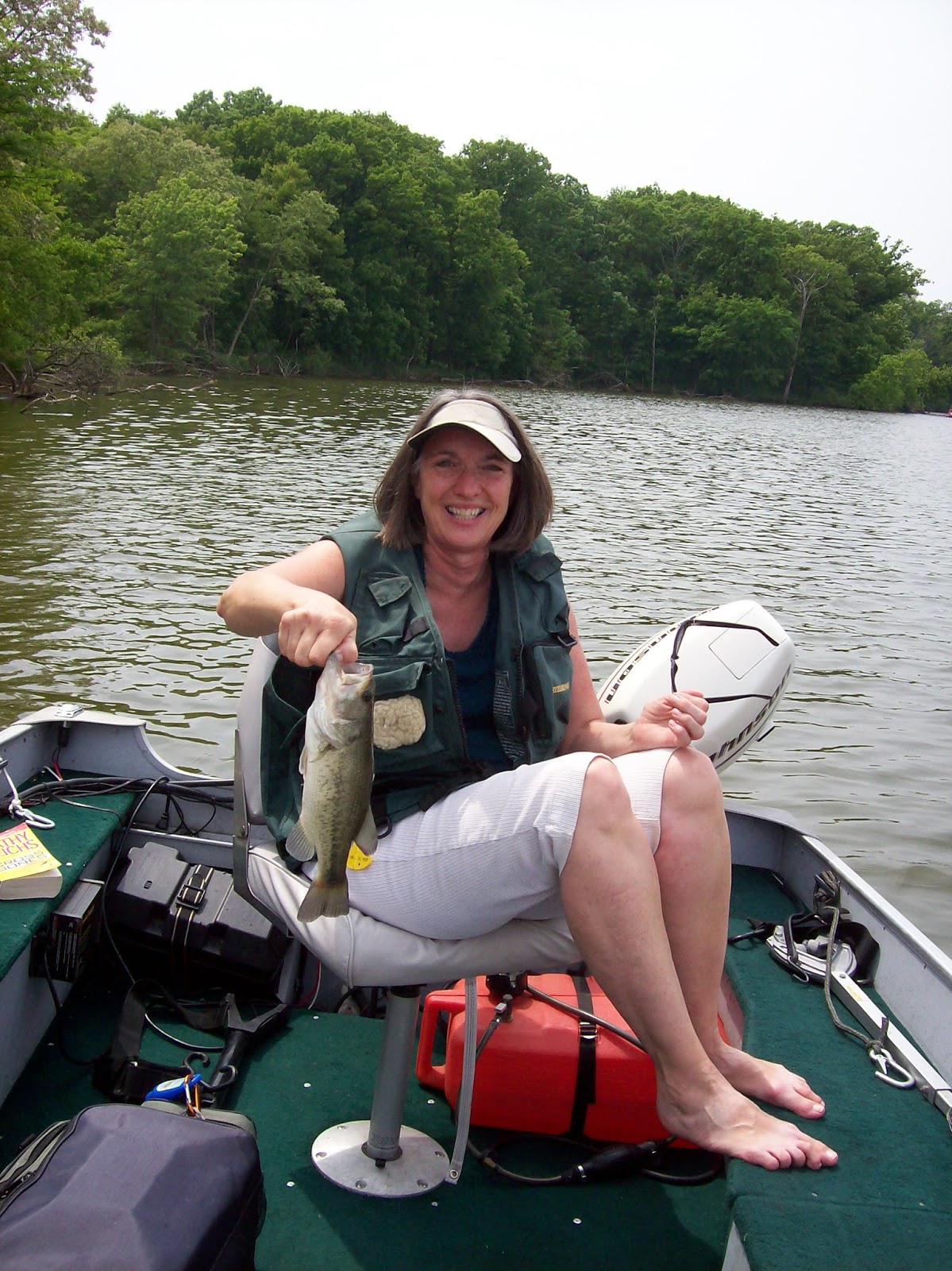
In spite of her lack of interest, she would pick up an throw out a line if we were stopped. She also was good at fishing and caught some fish.